For two years, the open-weights community has been closing the gap with closed frontier models — steadily, credibly, but always from behind. DeepSeek, Qwen, and Llama have each eaten into the lead, yet the top of every leaderboard remained a closed-lab affair. On 16 July 2026, Moonshot AI changed that framing. Kimi K3 is a 2.8-trillion-parameter mixture-of-experts model with a 1-million-token context window, native multimodality, and vendor-reported benchmarks that put it neck-and-neck with Claude Fable 5 and GPT-5.6 Sol on several agentic suites — and ahead of Claude Opus 4.8 and GPT-5.5 on others. The part that changes the market: Moonshot says the weights go open by 27 July.
The shift in one line
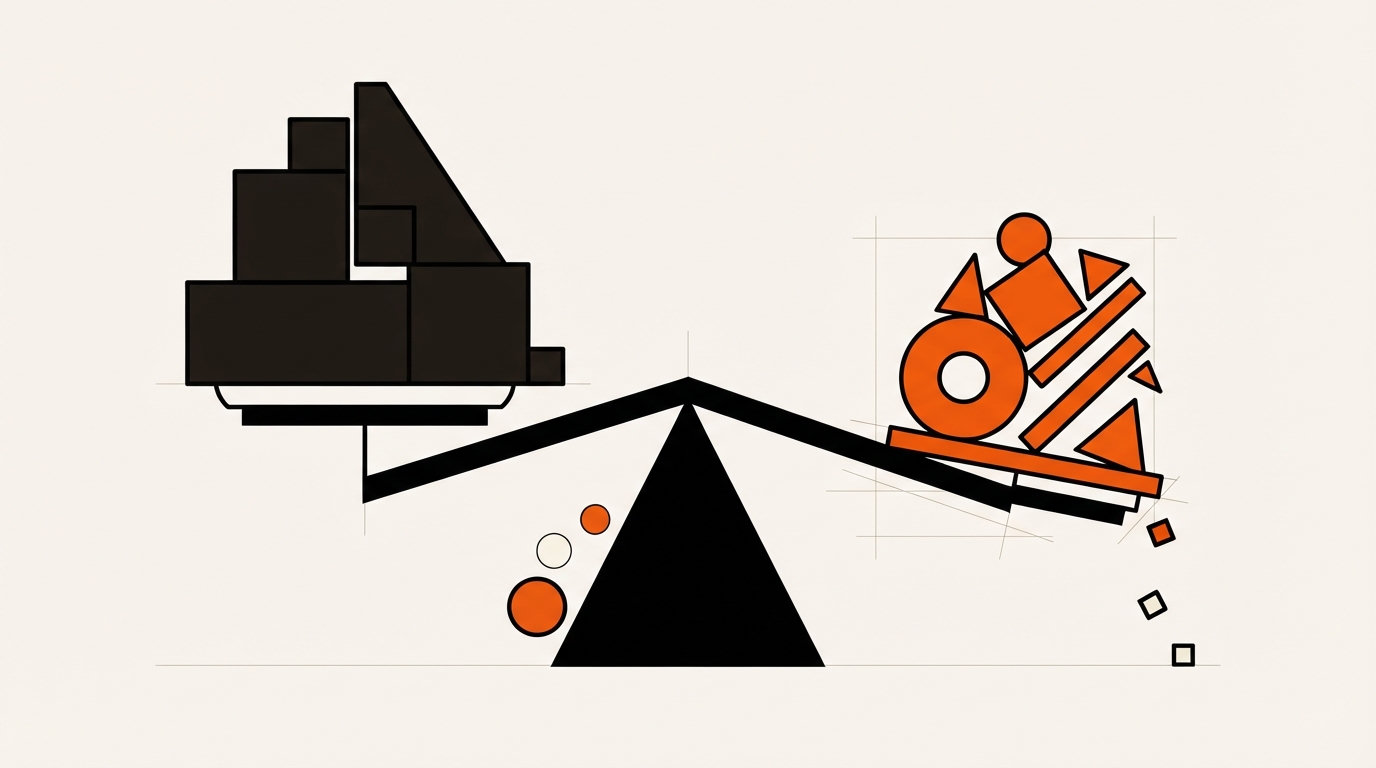
When a frontier-class model — one that trades blows with Fable 5 and GPT-5.6 Sol on agentic benchmarks — arrives with open weights, the gap between what you rent from a closed vendor and what you can run under your own control narrows from years to days. That reframes vendor lock-in from a technical inconvenience into a strategic choice with a visible alternative.
What actually shipped
Kimi K3 is Moonshot AI's most ambitious release to date — and the largest open-weights model announced, exceeding DeepSeek V4-Pro's 1.6 trillion parameters and Zhipu AI's GLM-5 series at 744 billion. It is a sparse mixture-of-experts system: 2.8 trillion total parameters, but only 16 of 896 experts activate per token, thanks to Moonshot's Stable LatentMoE routing framework. That matters because total parameter count describes capacity; active parameter count describes what you actually pay to serve. Moonshot claims roughly 2.5× better scaling efficiency than K2 on this front.
The model launched across Kimi.com, Kimi Work, Kimi Code, and the Kimi API on 16 July 2026. The API is live now, priced at $3 per million input tokens and $15 per million output — with cache-hit input at $0.30. Open weights are scheduled for 27 July, a ten-day window that Moonshot has publicly committed to. Two architectural innovations underpin the release: Kimi Delta Attention, a new attention mechanism designed to keep long-context compute tractable, and Attention Residuals, which preserves information across deep transformer layers.
Where it lands on the benchmark map
Moonshot's own benchmarks — which still need independent confirmation once the weights are public — place K3 in genuinely contested territory with the closed frontier. On several agentic and coding suites, it reportedly trades blows with Fable 5 and GPT-5.6 Sol, and beats Claude Opus 4.8 and GPT-5.5 outright on others. It tops Arena's front-end coding capability chart. Moonshot's blog is notably honest about the limits: it acknowledges K3 still trails Fable 5 and GPT-5.6 Sol on the hardest measures, even while crowding them on most.
The honest read is not "open has won." It is that open has arrived at the same table. A model within a point or two of the closed frontier — and ahead on specific tasks — is no longer a budget compromise. It is a genuine option for production workloads where the last few points of accuracy are not worth the premium, the lock-in, or the geopolitical exposure of a single Western vendor.
| Model | Origin | Weights | Context | Input / 1M | Output / 1M |
|---|---|---|---|---|---|
| Kimi K3 | Moonshot (CN) | Open (Jul 27) | 1M | $3 | $15 |
| Fable 5 (max) | Anthropic (US) | Closed | — | $10 | $50 |
| GPT-5.6 Sol | OpenAI (US) | Closed | ~1M+ | — | — |
| Grok 4.5 | xAI (US) | Closed | — | $2 | $6 |
| DeepSeek V4-Pro | DeepSeek (CN) | Open | — | — | — |
Read the pricing column carefully. K3's $3 / $15 sits between Grok 4.5's aggressively cheap $2 / $6 and Fable 5's flagship $10 / $50. But the comparison that matters most is not sticker price — it is total cost of ownership once the weights are open. When any inference provider can host K3, market pricing for hosted open models tends to undercut first-party APIs substantially. The DeepSeek effect is the precedent: a credible open model reset what buyers expected to pay across the entire market. K3 imports that pressure into the frontier tier.
The question stops being "which vendor should we lock into?" and becomes "is there a workload where we don't need a vendor at all — and what does that freedom cost us to exercise?"
Why open changes the decision
The strategic significance of K3 is not its parameter count or its benchmark scores. Those are impressive, and they may revise once independent testers get the weights. The significance is the combination: frontier-class performance and open weights and a firm release date. That triplet has not existed before. Here is what it changes for anyone currently buying or building on frontier models.
Vendor lock-in gets a visible exit
Teams that hard-wired themselves to a single closed provider — Anthropic, OpenAI, or Google — have accepted lock-in because the alternative was a measurable quality drop. When an open model sits within striking distance of the frontier, that calculus inverts. The cost of staying locked in is no longer "we get the best model." It is "we pay a premium and accept dependency for performance we could approximate under our own control." That is a different conversation with a CFO.
Data sovereignty becomes actionable
For regulated industries — finance, healthcare, government — the ability to run a frontier-class model inside your own perimeter, on your own infrastructure, with no data leaving your network, has been the holy grail. Until now, that meant accepting a model that was visibly behind. K3 narrows that gap to a margin many workloads can tolerate. The open-weights commitment means you can audit the model, fine-tune it, and deploy it without sending a single token to a third-party API.
Procurement leverage shifts to the buyer
When your fallback is "we could host K3 ourselves," your negotiation position with every closed vendor changes. You no longer need their model to function. You want it because it is better for a specific workload — and "better" is a term you can price. The existence of a credible open alternative caps what vendors can charge for the broad middle of the market, even if they retain the premium on the hardest tasks.
The production reality
None of this means every team should rip out their Claude or OpenAI integration and switch to self-hosted Kimi K3. The production realities of running a 2.8-trillion-parameter model are formidable. Even with only 16 experts active per token, K3 is not a model you spin up on a single GPU. It requires serious infrastructure: multi-GPU inference, expert routing, and the operational burden of keeping a frontier-scale model available, monitored, and updated. For most organisations, that is a capability they do not have and should not build unless the economics justify it.
What is more realistic — and what we expect to see first — is a split. Hosted open models, served by inference providers who specialise in this, will compete on price for the workloads where K3 is "good enough." Closed vendors will retain the tasks where their lead on the hardest benchmarks matters. And the system around the model — routing, guardrails, evals, tool integration — becomes the thing that determines whether you can actually exploit both options without rebuilding every time the market shifts.
Caveats before you replan your stack
The benchmarks are vendor-reported. The active-parameter count — the number that sets real serving cost — has not been independently confirmed. Kimi Delta Attention's efficiency claims need third-party evaluation; efficient-attention mechanisms have a consistent failure mode of saving compute while quietly degrading long-range quality. And a million-token context window is a spec-sheet number until someone publishes long-context recall results. The good news is that Moonshot committed to a date: on 27 July, all of these questions move from marketing claims to testable reality. Until then, treat K3 as a strong signal, not a settled fact.
What this means if you are buying or building AI systems
For consulting clients and internal platform teams, the practical response is the same one we recommended after Grok 4.5 landed — but with a new dimension. The model market is not just getting cheaper. It is getting an open frontier option. That changes the architecture question.
Assess which workloads need the closed frontier — and which do not
Most production agent loops do not run on the hardest benchmark tasks. They do retrieval, summarisation, classification, code generation, and tool orchestration at a level where "within a point or two of the frontier" is more than sufficient. Map your workloads by accuracy sensitivity. The ones that do not need the last few points are candidates for a hosted open model — now including K3.
Design for portability, not loyalty
If swapping K3 in for a slice of your Claude or GPT traffic requires a rewrite, your harness is under-built. Tools, guardrails, evals, and orchestration should outlive any single model. A unified routing layer lets you treat the model as a swappable component — and lets you exploit the price-performance arbitrage as the market moves, without rebuilding every release cycle.
Evaluate the data-sovereignty opportunity now
If you operate in a regulated industry and have been waiting for an open model that is "good enough" to run inside your perimeter, K3 may be the first candidate that clears the bar. Start the evaluation now — not when the weights drop on 27 July, but today, against the API. If the quality holds for your workloads, the open-weights release gives you a path to full sovereignty that did not exist a month ago.
Watch 27 July — and what follows
The weights release is the moment the claims become testable. Independent researchers will probe Delta Attention's quality, long-context recall, and real serving cost. If the benchmarks hold, the open frontier is real. If they degrade, K3 is still a strong model — just not the watershed its launch materials describe. Either way, the system you build around the model should not depend on the answer.
The executive takeaway
Kimi K3 is a genuine industry event because it collapses a distinction that has structured the entire market: the idea that frontier performance is something you rent from a small set of closed labs, and open models are what you use when you cannot afford the rent. When a 2.8-trillion-parameter model with near-frontier benchmarks arrives with open weights and a $3 / $15 API, that distinction stops being clean. The closed labs will still lead on the hardest tasks — for now. But the broad middle of the market, where most production agents actually live, now has a credible open alternative at the frontier tier.
The teams that win the next twelve months will not be the ones that pick a single model and defend the choice. They will be the ones whose systems can move with the market — routing to accuracy where it pays, to cost-performance where it does not, and to open weights where sovereignty or leverage matters. The model is no longer the product. The system around it is.
Key takeaways
- Kimi K3 is a 2.8-trillion-parameter MoE model with 1M context, matching Fable 5 and GPT-5.6 Sol on several benchmarks — with open weights promised by 27 July 2026.
- API pricing at $3 / $15 per million tokens sits between Grok 4.5's $2 / $6 and Fable 5's $10 / $50 — but the real cost advantage comes once the weights are open and inference providers compete on hosting.
- The strategic shift is not performance or price alone — it is the combination of frontier-class quality with open weights, which gives buyers a visible exit from vendor lock-in for the first time.
- Caveats remain: benchmarks are vendor-reported, the active-parameter count is unconfirmed, and Delta Attention's efficiency claims need independent verification once the weights land.
- The durable response is the same as after Grok 4.5 — model routing, portable harnesses, cost-per-task measurement — now with an open frontier option that adds sovereignty and procurement leverage to the equation.
Rethinking your model stack after Kimi K3?
We help teams design provider-agnostic agent systems that route for accuracy, cost, sovereignty, and leverage — and exploit the open-weights frontier without rebuilding every release cycle.