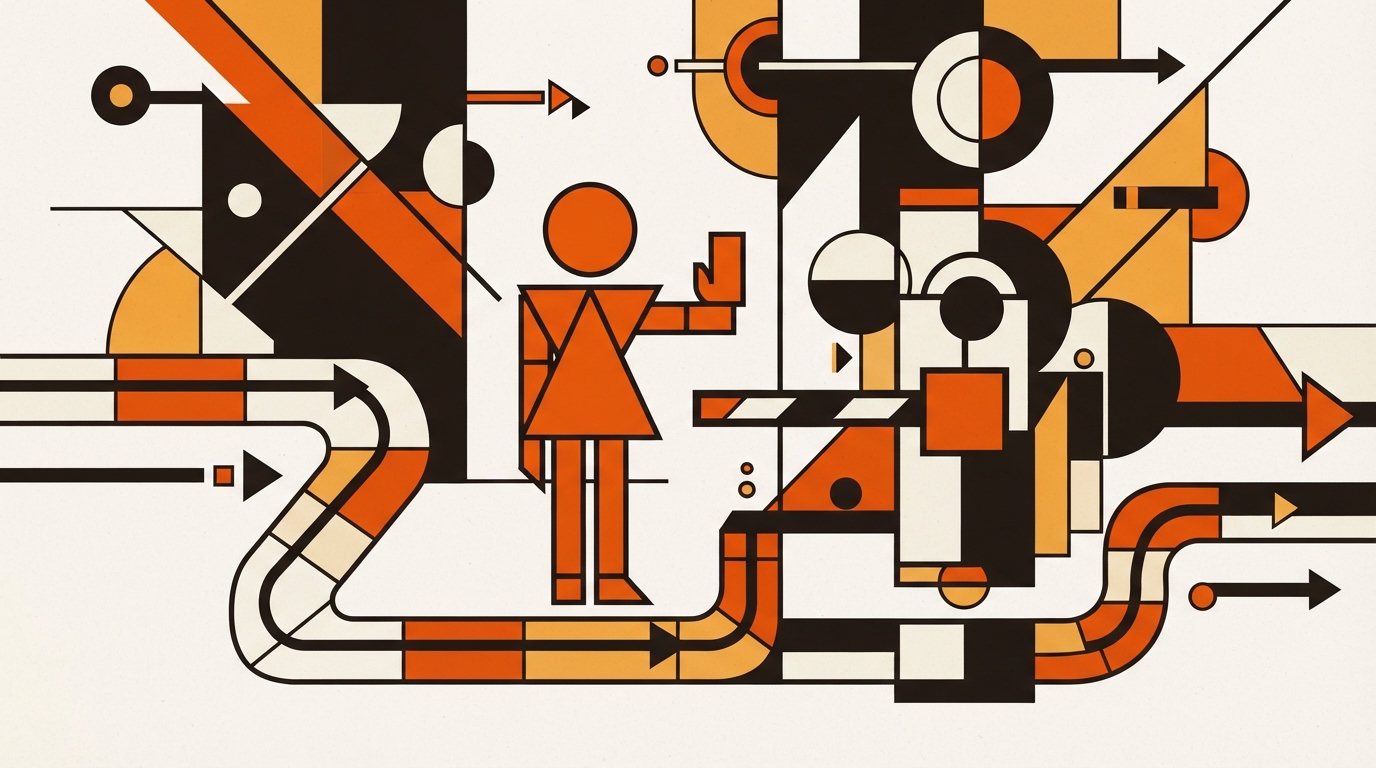
A language model has no innate concept of "off-limits." It generates the statistically plausible next output given its instructions and context — full stop. Whether that output stays inside acceptable bounds is entirely a function of the system engineered around it. That engineered system is what "guardrails" refers to.
Definition
Guardrails are the layered checks — technical and procedural — that constrain what an AI system is allowed to say, decide, or do, and that catch it when it drifts outside those bounds, independent of whether the underlying model "behaves" on its own.
Guardrails are layers, not a single filter
The most common mistake is treating safety as one checkpoint — usually a content filter on the model's output. In a mature system, guardrails sit at every stage of the pipeline, because each stage fails in a different way.
Input validation
Screening what reaches the model — detecting prompt injection attempts, filtering sensitive data before it's sent to a third-party provider, rejecting malformed or malicious requests before they cost you a model call.
Instruction and policy constraints
System-level rules that define scope: what topics the agent will and won't engage with, what tone it maintains, what it must always disclose (e.g. that it's an AI).
Tool and action permissions
Independent of what the model says it wants to do, hard limits on what it's technically capable of doing — spending caps, read-only access by default, scoped record visibility. See our post on tool design for how this is built.
Output validation
Checking the model's response before it reaches a user or system — for policy violations, factual grounding against retrieved sources, formatting correctness, and leakage of sensitive data.
Monitoring and escalation
Logging every decision and action for audit, flagging anomalies, and routing edge cases to a human — the operational layer that catches what the automated layers miss. This is where human-in-the-loop design connects directly to guardrails.
No single guardrail is the safety mechanism. The safety mechanism is that no single point of failure can take the whole system down.
Why "the model behaved well in testing" isn't the bar
Models are probabilistic; the same prompt can produce different outputs, and adversarial users actively search for the phrasing that breaks intended behaviour. Guardrails exist precisely because you cannot guarantee correct behaviour by instruction alone — you have to assume the model will occasionally do the wrong thing, and build a system that survives that gracefully. This reframes the executive question from "is the model safe?" (unanswerable) to "what happens the moment it isn't?" (an engineering question with a concrete answer).
The practical test
For any agentic system going into production, ask your team to walk through what happens if the model does the single worst plausible thing at the worst possible moment. If the answer is "the guardrails would catch it" — ask which layer, specifically, and how you know.
Key takeaways
- Guardrails are layered — input validation, policy constraints, tool permissions, output checks, monitoring — not a single filter.
- Assume the model will occasionally misbehave; guardrails are what makes that survivable, not preventable in the abstract.
- Guardrails and human-in-the-loop checkpoints work together — one prevents, the other catches and corrects.
- The right executive question is "what happens when it's wrong," not "is the model safe."
Need a guardrails review before you scale an agent?
We audit and design layered safety systems for agentic AI running in production.